At this stage of the project, I started exploring how to create natural weather sounds using Pure Data (Pd). I mainly focused on two sounds: wind and rain.
Although wind and rain sound different, I noticed that they share some common characteristics. Both sounds can continue for a long time, but they are never completely the same. Their intensity, texture and density constantly change.
For example, wind can become stronger or weaker, with occasional gusts. Rain also changes over time. Sometimes we can hear individual raindrops, while at other times the sound becomes denser and more continuous.
I wanted to explore these characteristics through sound synthesis instead of simply playing pre-recorded weather sounds. My main idea was to use noise, filters and random processes to create sounds that can continuously change over time.
During my research, I read Boya Zhang’s paper Synthesis of Natural Sound Based on Nyquist (2024). The paper explores how natural sounds, including rain, wind and thunder, can be generated using unit generators in the Nyquist programming language.
Zhang uses different sound generation methods, such as noise generators, filters and amplitude envelopes, to create natural sound effects. The research also explores how randomness and changes in sound intensity can make the generated sounds more natural.
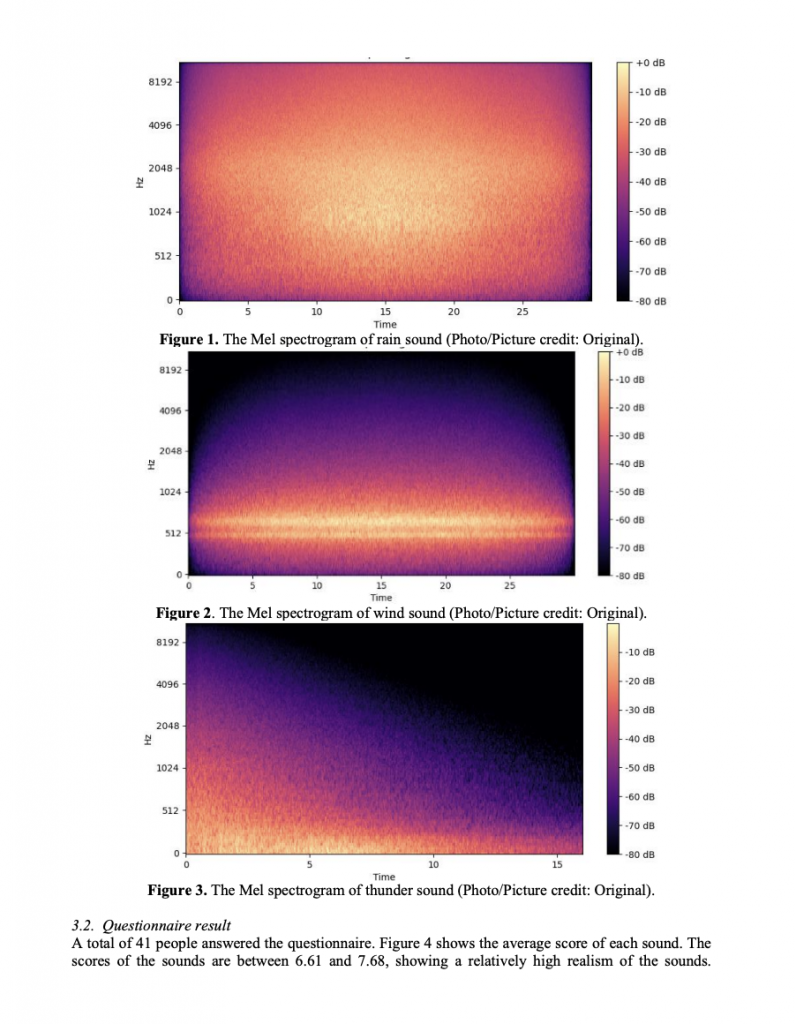
This paper gave me inspiration for my own project. Although I use Pure Data instead of Nyquist, I was interested in the idea of using basic sound elements and programming rules to generate natural sounds. It also encouraged me to explore how different parameters could change the texture and behaviour of wind and rain.
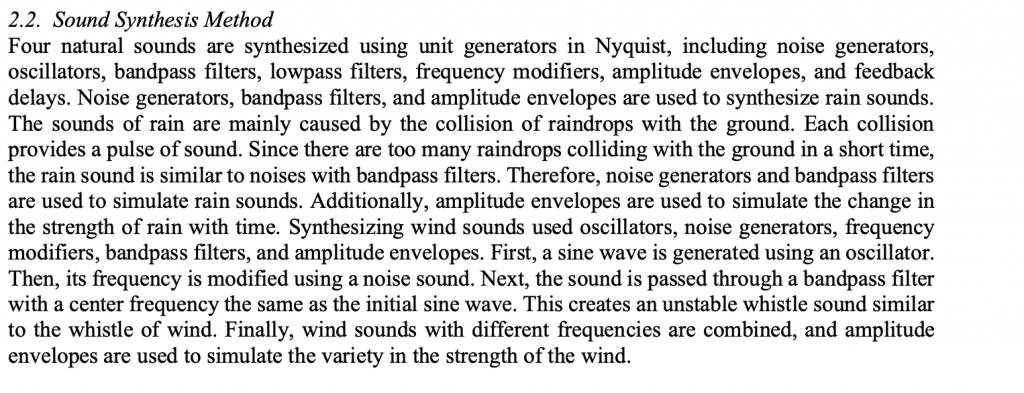
https://ace.ewapub.com/article/view/13069.pdf
Wind Generator
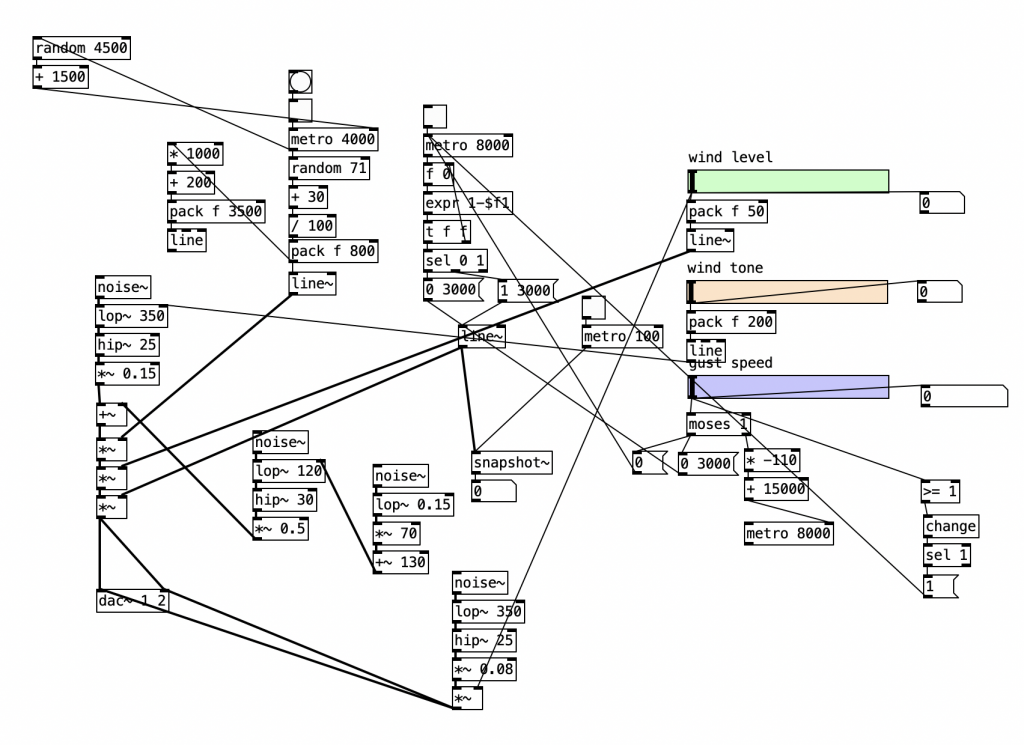
When developing the wind generator, I first used continuous noise in Pure Data as the basic sound source.
I chose noise because wind usually does not have a clear musical pitch. Instead, it sounds more like continuous moving air.
Next, I used filters to shape the noise and change its frequency range. This helped me create a softer and deeper wind sound instead of simple white noise.
After my first experiments, I felt that the wind sounded too static. Although it was continuous, it did not have enough movement.
To improve this, I added a gust system. This system changes the intensity of the wind over time, creating stronger and weaker moments. I also experimented with automatic gusts, allowing the wind to change without constant manual control.
Finally, I added a slider to control the wind level, allowing me to adjust its intensity.
Rain Generator
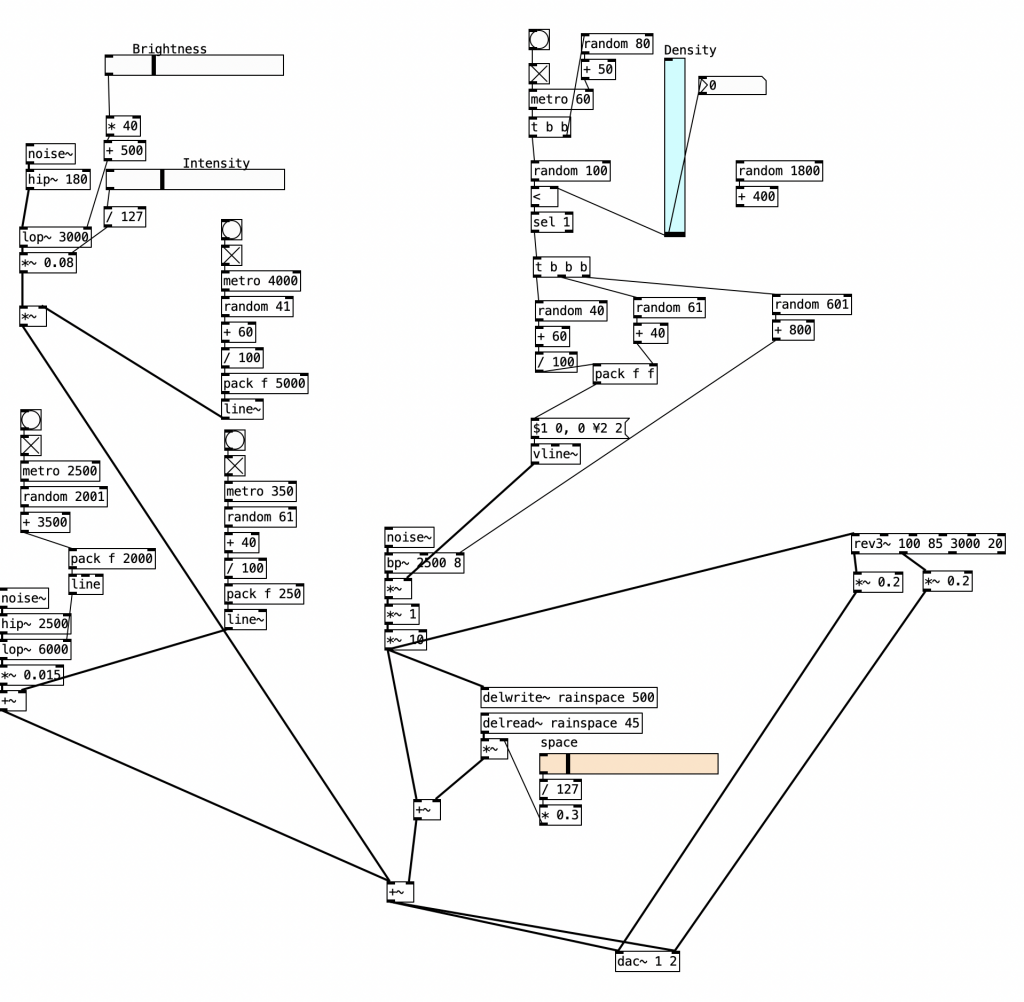
When developing the rain generator, I also started with noise, but I wanted to create a different sound structure.
Unlike wind, rain contains many individual small sound events, such as the tiny impacts of raindrops hitting different surfaces. I therefore experimented with noise, filters and random pulses to create the sound of raindrops.
Random pulses were important because I did not want the raindrops to follow a fixed rhythm. Their timing and density needed to change naturally.
I also experimented with different filter settings to change the texture of the rain. I wanted to move away from simple white noise and create a softer sound that could suggest rain falling on different surfaces, such as leaves or soil.
Reflection
Through this project, I gradually realised that creating natural sounds is not simply about generating noise. The most important part is how the sound changes over time.
I found that random processes can help reduce repetition, while filters and volume controls can further shape the characteristics of the sounds.
I also started thinking about how these two sound generators could work together as part of a larger natural sound environment.
In the next stage, I want to explore how wind and rain can interact with other sounds, such as birdsong and insects. I hope to develop a system in which different natural sounds can be combined and controlled to create constantly changing soundscapes.
Rather than simply reproducing a fixed recording of nature, I want to create an instrument that can generate different natural environments.
Reference
Zhang, B. (2024) ‘Synthesis of natural sound based on Nyquist’, Applied and Computational Engineering, 68, pp. 171–176. Available at: https://doi.org/10.54254/2755-2721/68/20241431.
Leave a Reply
You must be logged in to post a comment.