After completing the wind and rain generators, I started developing the birdsong section of my nature sound synthesizer.
Part of the inspiration for this project came from a guest lecture by Coral Rose Kindred-Boothby. During the lecture, I was introduced to her work using a light sensor to control birdsong. This made me think about how sensors and physical movements could be used to control electronically generated bird sounds, rather than relying on traditional keyboards or buttons.
Inspired by this approach, I decided to experiment with a distance sensor to create a Theremin-like interaction system. My idea was to allow users to control different bird calls simply by moving one hand at different distances from the sensor.
In terms of sound, I wanted to develop a generative system that could produce birdsong with variation and randomness, rather than simply playing recordings of real birds. I used Pure Data to develop the system. The development process was divided into two main parts: creating the birdsong generator and building a six-voice system with distance-based interaction.
The first stage was to develop the birdsong generator itself. I experimented with several techniques in Pure Data, including random selection, oscillators, noise generation and frequency modulation.
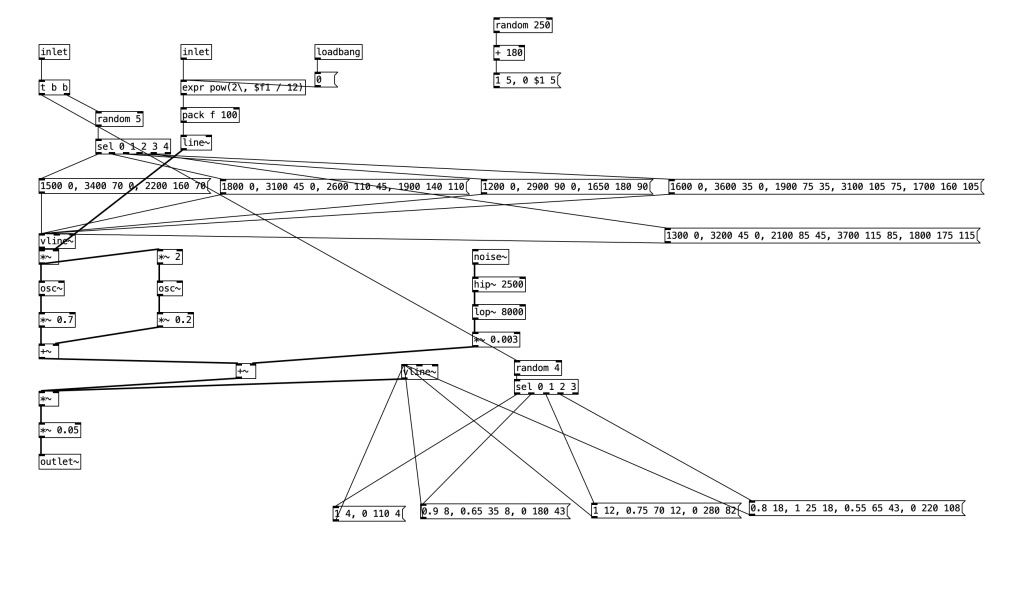
First, I created several pitch patterns using Message objects. These messages contain different frequency sequences, allowing each bird call to have a different pitch movement over time.
I then used [random] and [sel] to randomly select between these pitch patterns. This means that the system can choose different sequences whenever a new bird call is triggered, reducing repetition.
For the sound generation, I used two oscillators. The first oscillator produces the main sound, while the second adds another frequency layer to make the overall sound richer. I also added a noise layer using [noise~], together with high-pass and low-pass filters to shape its frequency content. This adds an additional texture to the birdsong.
For pitch control, I used [vline~] to create changes in frequency over time, rather than keeping the sound at a fixed pitch. Finally, I combined the different sound layers to create the final output. I also experimented with random amplitude envelopes to introduce subtle differences between individual bird calls. Through these experiments, I wanted to move away from simple electronic beeps and create sounds with more movement and variation.
After completing the individual birdsong generator, I wanted to create a more complex system in which multiple bird calls could overlap.
To achieve this, I developed a system consisting of six independent voices in Pure Data. Each voice is an independent abstraction called final_birdvoice. Each abstraction contains its own sound generation process and can be triggered independently.
I also assigned different pitch settings to the six voices. These parameters are automatically loaded when the main patch opens, so I do not need to manually click each Message box to set the pitches every time I open the system.
In the audio output section, I used a series of [+~] objects to gradually combine the individual audio signals from all six voices. I then added a final volume control using [*~ 0.15] before connecting the signal to [dac~ 1 2] for stereo output.
This allows all six voices to play simultaneously without one voice immediately interrupting the others. Through this process, I developed the original sound generator into a polyphonic system capable of producing overlapping birdsong.
After completing the six-voice system, I began exploring how to apply the interaction idea that had initially inspired me during the guest lecture.
Inspired by Coral Rose Kindred-Boothby’s use of a light sensor to control birdsong, I wanted to experiment with a different form of physical interaction. I chose to use a distance sensor, making the distance between the user’s hand and the sensor the main control input.
My aim was to create a Theremin-like playing experience using one hand. Instead of touching the instrument, users would be able to trigger different bird calls by changing the position of their hand.
Before connecting a physical distance sensor, I first used a Slider in Pure Data to simulate the distance input. This allowed me to develop and test the control system without needing the actual hardware.
Rather than continuously changing the pitch according to distance, I decided to divide the detection range into six different distance zones. Each zone corresponds to a different voice.
First, I used [expr] to process the Slider values and convert them into six separate distance zones. I then used [change] to detect when the value moved from one zone to another. Finally, [sel 1 2 3 4 5 6] sends the corresponding trigger to each bird voice.
I chose a bidirectional triggering method. This means that moving the hand either closer to or further away from the sensor can trigger a new bird call.
An important feature of this design is that the user does not need to move their hand completely outside the detection area before triggering another sound. Moving into the next distance zone is enough to trigger a different bird call.
By using the Slider to simulate distance, I was able to gradually adjust the distance zones, triggering logic and the relationship between the different voices.
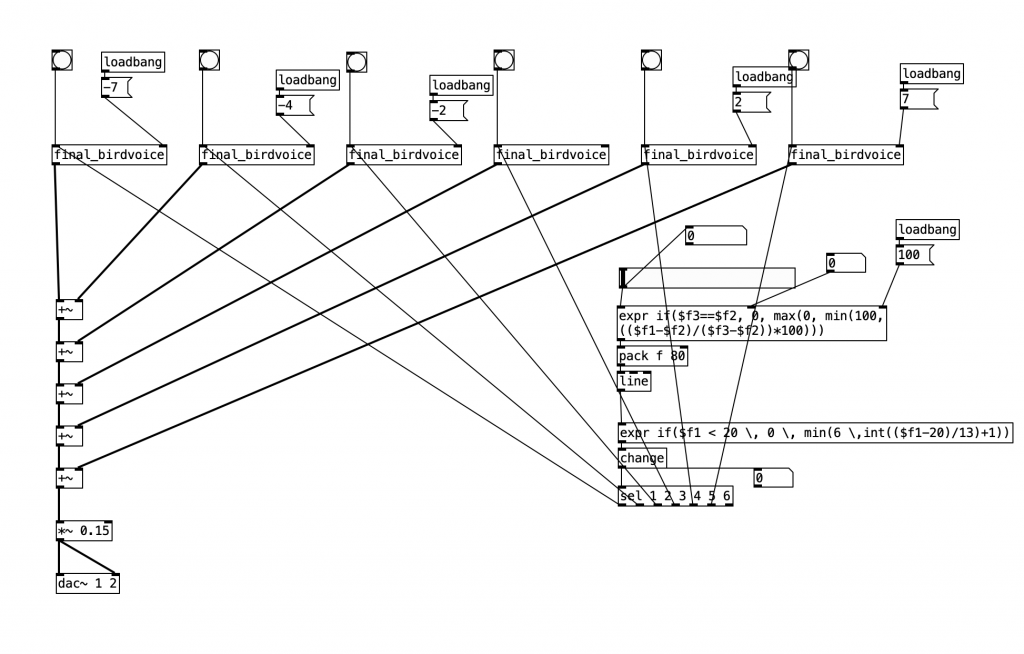
The Slider currently simulates the input from a distance sensor rather than measuring physical distance. In the next stage, I plan to transfer the system to Bela Stereo and connect a physical distance sensor to enable real-time hand-distance control.
Leave a Reply
You must be logged in to post a comment.