Recently, I’ve been learning Pure Data and Bela, and trying to combine them to build my own noise box. The whole process is new but exciting to me, and it makes me gradually understand the structure and logic behind the world of sound.
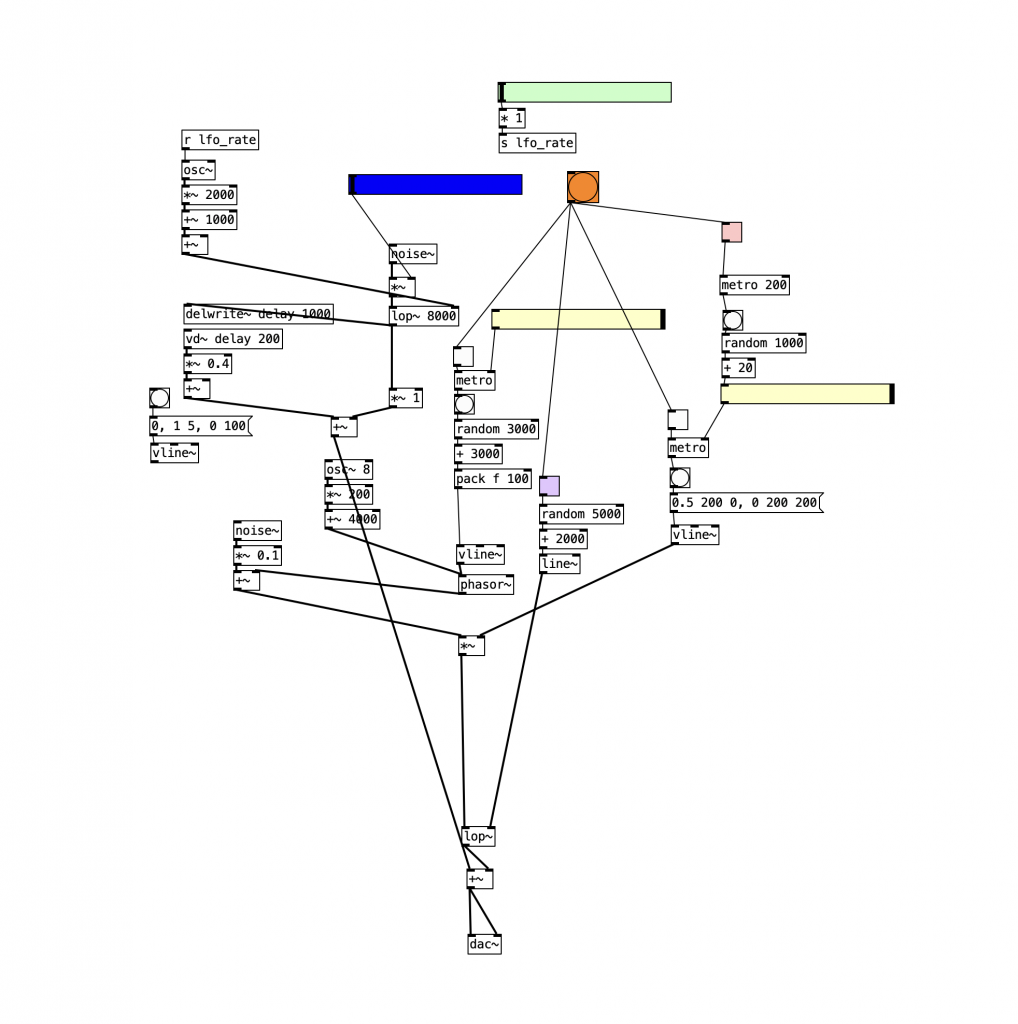
I started by designing the system on the Pure Data side. My idea was to create a small sound engine that can simulate natural sounds, so the noise box would not only produce abstract noise, but also create layers, rhythm, and variation like a natural environment.
In Pure Data, I made several natural-sound modules:
Waves or rain sounds:
Using a noise source (noise~) with filters and envelope changes, I generated textures similar to water and wind. But after testing many times, I noticed that I still need to improve the “breathing” of the waves. In the low-tide parts, the sound becomes too clean and completely silent. I want to add some subtle background noise there to make it more natural, flowing, and continuous.
Bird-call simulation:
I used random functions, oscillators (osc~), and vline to build a small module that randomly triggers short tones to imitate bird calls. It’s not very realistic yet, but it has a unique character. It made me realize that simulating natural sounds is not just copying them—it’s about understanding their structure and recreating them in a new way.
Even though these sound simulations are still rough, they are very important experiments for me. Through them, I’ve learned how PD’s signal flow works, how filters shape sound, the details of envelope design, and how to build complex soundscapes from simple elements. All of this motivates me to keep learning.
In this project, although I chose to design sound for a film clip, I am also exploring sound coding at the same time. I am gradually realizing that sound is not just something we listen to—it can be designed, shaped, and built. Natural sounds can not only be recorded, but also understood in new ways, broken down, and recreated through synthesis.
Leave a Reply